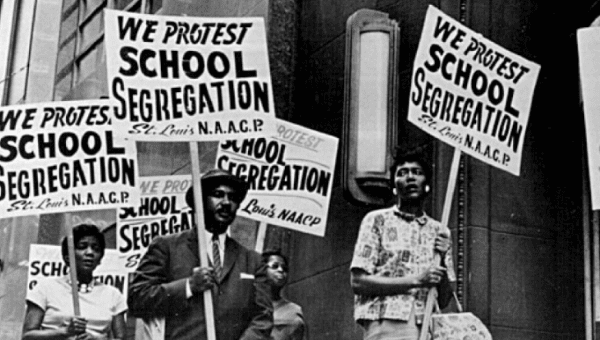
based on both their race and social class. In Goldstein’s The Only Valid Passport from Poverty, the
author describes the evolution of desegregation. In this slow moving process, we find that many had
opposing views on desegregation, exemplifying both positives and the negatives of the process at
that time. Goldstein states, “...there had been concern in the black community that merging black
and white schools could decimate the black middle class, which depended on jobs in segregated
schools.” (111) Many states were attempting to “equalize teachers” but what that really meant was
black educators being fired or replaced by their white counterparts, and black students being turned
away by white schools. Mirroring last week’s readings regarding community, this article quotes Anna
Julia Cooper who said, “...in black schools led by black educators, ‘children were more likely to take
pride in themselves and the achievements’ of their race” (112) This notion mirrors Bogg’s idea that
teachers from inside the community or teachers who have similarities to students are best.
In order to help “force” desegregation into place, money became involved, and that came with the
Elementary and Secondary Education Act (ESEA) in 1965. Goldstein explains, “States that offered
their low income students more state-level funding would be rewarded with more money from the
federal government.” (114) Many schools were pushed into integration so they did not lose funding.
The article reveals the struggle of integration, not only racism and fears, but the termination of black
teachers and their decline in the profession because of it. Black teachers were replaced by whites
who were unprepared, simply earning rights to the job because of their race. Certifications were
revoked from black teachers. Short-cut teaching certification programs were created. Teachers faced
challenges they could not overcome. President Johnson’s experience along with other teachers’ in
the classrooms show how difficult it was to teach and help students really learn while being up
against some terrible working conditions.
In Anyon’s Social class and the hidden curriculum of work the author presents results of a study in
five different elementary schools in New Jersey of various social classes. The author argues that the
work in each school has a “profound implication for theory and practice in education.” As I continued
to read, I was struck by the truth behind the study. After being provided with clear examples of each
type of work, I realized that many schools do simply aim for that “good enough” education and have
set their objectives even before meeting the students. Their futures are predetermined in many
cases by their social class and communities, and students will be limited or will exceed because of
them. School work varies from “following steps of a procedure” in the Working-class Schools to
“developing one’s analytical intellectual powers” in the Executive Elite Schools. Students are working
on perfecting the skills presented to them by their predetermined “hidden curriculum”. This author
argues that student’s jobs and capital are predetermined (based on their work) and provides
numerous examples.
1. “The working-class children are developing a potential conflict relationship with capital.” (88)
2. In middle-class schools “the work tasks and relationships are appropriate for a future relation
to capital that is bureaucratic” (88)
3. “In the affluent professional school the children are developing a potential relationship to capital
that is instrumental and expressive and involves substantial negotiation.” (88)
1. “The working-class children are developing a potential conflict relationship with capital.” (88)
2. In middle-class schools “the work tasks and relationships are appropriate for a future relation
to capital that is bureaucratic” (88)
3. “In the affluent professional school the children are developing a potential relationship to capital
that is instrumental and expressive and involves substantial negotiation.” (88)
The students in working class will be denied the opportunity to be creative and those of affluent
schools will possess the skills to be artistic and innovative, therefore, predetermining many future
career paths of these individuals.
career paths of these individuals.
The challenges we face today as educators are reflected in these readings. Sadly, racism,
segregation and a hierarchy of social class still exist in education, whether we want to admit it or not.
Many teachers still hold students to a certain “standard”, high, or low, or anywhere in between,
based on a student’s community, parent’s income, race, or social class and even more. In an attempt
to break those barriers and help individuals see their potential for creativity and growth, teachers in
traditional classrooms can only do so much. I hope to help my students, of all backgrounds, discover
that their futures can really be whatever they wish. However, I do know that my school is from a
community of a certain social class, and although I have their best interests in mind, am I, too,
unknowingly preparing them for predetermined future? Hmm…
I think that the mindset you mention in your last paragraph, of wanting to help students of all backgrounds reach their full potential, is the only one a teacher should have. I was disheartened as I read Anyon's article and saw the way some of the "working class" teachers interacted with their students. Even with a specific curriculum to teach, it should not be that difficult to have some compassion for those in our classroom. No matter how powerless we might feel in the grand scheme of educational policy, if there's one thing we can do it's to be a positive influence in a child's life. If we teach with a hopeless attitude, our students will not feel any more hopeful than we do.
ReplyDeleteI agree with Alexandra! I've had educational experiences in both working-class and middle-class school districts, and I can tell you which turned me away from education, and which encouraged some degree of creativity from me. Educational systems *should* want to help students of all backgrounds reach their full potential, which is why I find that funding tied to property taxes is perhaps the most inequitable method of providing this support. In a state as small as Rhode Island, it would be great to participate in an updated "lively experiment' and move away from multiple districts and consider a state regionalized district to more equitable distribute funding. It would be a re-commitment to Dewey's democratic education, encourage a more collective way to address our children's future, and prove that we as citizens do value education as a public good.
ReplyDelete"Many teachers still hold students to a certain “standard”, high, or low, or anywhere in between, based on a student’s community, parent’s income, race, or social class and even more. " - Sadly I have seen this in action as well. How many times have we heard in the lunch room that certain students "just aren't capable of" certain types of learning. I know that in the media that "older teachers" tend to take the brunt of this type of criticism however I have seen this across the age spectrum. I agree that we need to set fair and high standards for ALL students regardless of race, gender, or other identifying factors. Also, I love the title of your blog post! Very fitting and poignant.
ReplyDelete