This week, we watched Precious Knowledge, by Ari Palos and Eren Isabel McGinnis, a documentary about Mexican-American students and their Ethnic Studies courses in school.
It definitely took me a few minutes to pull myself together after watching this documentary,
because to me, it ended on a sad note for these students when the law was passed to ban
Ethnic Studies. Although the ban was passed, the students and teachers were also hopeful.
It showed students during their last days of school talking about how their revolution for change
is just beginning.
It definitely took me a few minutes to pull myself together after watching this documentary,
because to me, it ended on a sad note for these students when the law was passed to ban
Ethnic Studies. Although the ban was passed, the students and teachers were also hopeful.
It showed students during their last days of school talking about how their revolution for change
is just beginning.
As educators, what more would we want for our students than for them to have a good
relationship with school? The documentary followed Crystal, Priscila, and Gilbert, three
Mexican-American students in Tucson and initially displayed their lack of interest in school,
explaining how they were disengaged and bored, finding little to no reason to attend. Crystal
had to care for her siblings while Priscila did not even attend her freshman year while her
dad was arrested and jailed for being an undocumented immigrant. Gilbert lived in a packed
house with no father and had a constant feeling of hate towards education. He says, “I feel
like it’s against me.”
With the dropout rate for Mexican American students at 50%, it's no wonder educators felt
the need to make a change and create class curriculum geared toward Mexican-American
students. Dr. Jeff Duncan-Andrade, an Ethnic Studies advocate stated, “There’s nothing
wrong with kids. I’ve never met a kid with a dysfunctional relationship towards learning, I
have met lots of kids with a dysfunctional relationship towards school.”

When the curriculum was created and students elected to be in Ethnic "Raza" Studies, their
attitudes towards school began to shift. The students in this documentary were saying, “I
want to go to this school” and “I hate it when I can’t be here.” It reminded me of Neason's
How Hawaiian came back from the dead. Students want to and should feel a connection to
their learning. If interest and engagement rise, student achievement will rise. Dr. Augustine Romero,
How Hawaiian came back from the dead. Students want to and should feel a connection to
their learning. If interest and engagement rise, student achievement will rise. Dr. Augustine Romero,
Director of Student Equity, TUSD asks an important question, a question that we have been
examining throughout our studies in this class as well when we looked at the work of Jean
Anyon, Grace Boggs, and Dr. Goss. He asks, “Do our schools inspire the community or
does the community inspire our schools? We choose the latter.” The community should
inspire the schools and the work that is happening daily in classrooms. This program is a
perfect example of that work.
If students were engaged and interested in what they were now doing in schools, why mess
with it? Why fix something that isn't broken? Well, the Superintendent of schools at the time
accused them of being tribal, racist, and rude. Many people were saying the Raza Studies
students were preparing for “la reconquista” and were learning hate speech and how to be
Anti-American. Some media avenues even went as far as comparing them to the KKK. The
politicians and administration were discussing the elimination of these classes without ever
personally witnessing what happens in them. Richard Miranda, State Senator, says, “You’re
trying to eliminate Ethnic Studies without even going to the classrooms.” This is a problem
with many educational policies even today, as we have discussed in class. The people who
“make the rules” (the “higher ups”) and are those who are furthest away from the actual
classroom setting itself.
In the end, Gilbert’s quote really echoed in my mind. He says, “Think about it, I mean, we’re
all human, we all got hearts that beat, we all got, you know, minds that think. And people
don’t treat each other like we’re humans. They treat others like they’re animals like they
shouldn't be a part of this society but you know We create a society, a Dystopia, where we
oppress each other and we don’t really appreciate one another. But you know, we’re all
human, what’s the big deal… I just believe in one race, the human race.”
I couldn’t agree more with Gilbert. The students, teachers, and classes represented in this
video gave me hope. It made me feel the need to inject more culture into my Spanish
classes and to ask my students more about their own cultures and bring that to life in the
classroom everyday. Ron Espiritu gave a TED talk on “Why Ethnic Studies Matter” and
explains it here.
He asks “Why do we have to wait to college until we have these experiences? Shouldn’t it
be available for our young people in high school and elementary schools across the nation?
I think so.” (Espiritu) Yeah, why do we? We should push to incorporate this curriculum in
secondary schools.
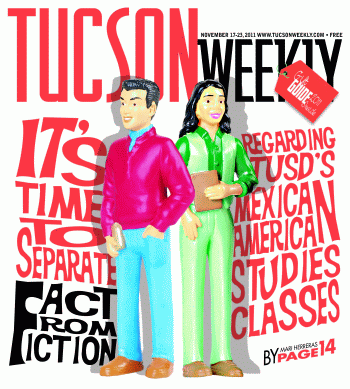
I also found an interesting article debunking Ethnic Studies Myths. In one myth, the article
highlights, Nolan Cabrera, an assistant professor at the University of Arizona and a
supporter of the Raza Studies program where he says, "There is no Chicano-studies math,
but those gaps began to close, too," he says. "That tells me it's not just about teaching the
student, but changing their orientation to school in general." (Herreras)
While watching this documentary I faced a roller coaster of emotions. Disheartened that
students were disengaged and uninterested in school, happy and ecstatic they finally were
passionate about learning, and devastated that had it all taken away. However, the students
positive attitudes and what they took away from their learning was something they will carry
with them for life. The life lessons they learned in those classes can never be taken away. I
wanted to be a part of this class! The passion the educators have in that school and Ethnic
Studies program are immeasurable. The documentary was so moving to me and I am
thankful we had a chance to watch this for our course. Almost ten years later we are still
facing some of the struggles that were presented. We must embrace the challenge and
continue to fight for the needs of all students.
I also was really upset after I watched this documentary. It was dripping with people unaware of white privilege and completely unaware of how their words can affect the CHILDREN they are speaking to and about! Honestly, it is America at its worst.
ReplyDeleteI think you made a great point here: "This is a problem with many educational policies even today, as we have discussed in class. The people who “make the rules” (the “higher ups”) and are those who are furthest away from the actual classroom setting itself."
And people are so easily swayed by a couple of key phrases or sayings that voters will follow blindly behind these politicians. Yet another reason to better educate our youth!
I also wrote the same quote down while watching the video- “There’s nothing
ReplyDeletewrong with kids. I’ve never met a kid with a dysfunctional relationship towards learning, I
have met lots of kids with a dysfunctional relationship towards school.” I think this is an important thought. We have to remember that all children have the capacity to learn, but when their relationship with school is tense and stressful, they are not in a position to be ready to learn. The myth you described demonstrates this perfectly- when students are enrolled in ethnic studies classes their relationship with school improves, therefore they are able to learn and close the skill gaps in other subjects like math.
I thought about you watching this and can only imagine how sad you must have been. I felt like I shook my head multiple times. They way it ended was such a moment of defeat. But because of this more and more schools are developing ethic studies curriculum.
ReplyDeleteGilbert, I felt was so wise. I noticed you pulled out the same quote from his ending statement as I did, "We create a society, a Dystopia, where we oppress each other and we don’t really appreciate one another. " These ethnic classes was teaching student acceptance of who they are and of who others are. Acceptance and appreciation, simple ideas with a huge impact. This is what we need to teach not eliminate.