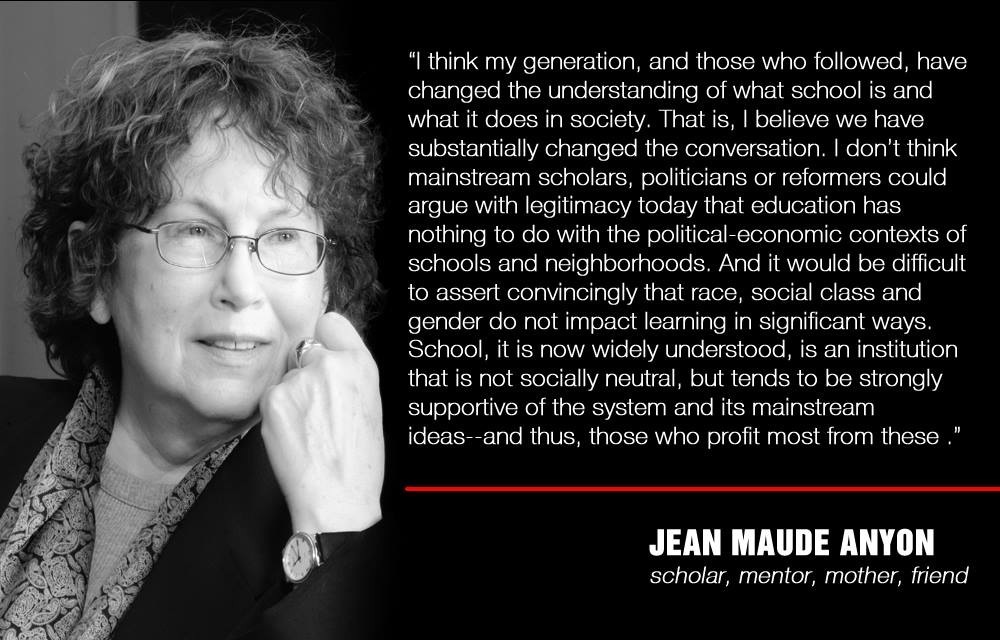
This week, we read a chapter by Jean
Anyon called, “What “counts” as educational policy? Notes toward a new
paradigm.” In this chapter, she
investigates educational experiences made available to students of various
social-class contexts, examines reforms in urban education, and presents her thoughts on
education policies over the past seventy-five years, highlighting the reasons
behind why failing education policies are systemic in low-income, inner-city
areas. In addition, she provides the reader with evidence that poverty directly
impacts a student’s education.
Anyon states, “Of countervailing
power, however, is research demonstrating that when parents obtain better
financial resources or better living conditions, the educational achievement of
the children typically improves significantly. These findings empirically
support the argument that for the urban poor, even with the right educational
policies in place, school achievement may await a family’s economic access.”
(74) In doing research on the topic, I found an article online called, "Poverty and School Funding, Why low-income students often suffer." This article reiterates some of Anyon's major points. Anyon also delves into how income allows parents and families the access to
better resources, less emotional stress, fewer health and behavior issues,
better living conditions, and many more.
The author also points out the
importance of understanding that poor students and low intelligence does not necessarily
go hand in hand, and that economics can either be a guiding path or a hurdle
for students regarding their education. Anyon presents the results of a study
showing how a family’s socioeconomic status (SES) does impact a child’s
cognitive ability and that poverty has a negative impact on early intellectual
achievement. A study demonstrated that “the disadvantages of being poor
outweigh by far the race or family structure of children as causes of the
cognitive disadvantages.” (76)
Anyon outlines overwhelming amounts
of evidence to prove that increased familial supports such as financial
resources and less segregated neighborhoods raise educational achievement, and,
mentions that what happens to children during their early years can have
life-long implications. In her conclusion, she mentions, “As education
policymakers and practitioners, we can acknowledge and act on the power of
urban poverty, low-wage work, and housing segregation to dwarf the most
curricular, pedagogical, and other educational reforms. The effects of
macroeconomic policies continually trump the effects of education policies.”
(83) After reflecting on her chapter, I was reminded of the community concept.
We can debate pedagogical policies and a “one-size-fits-all” solution to educational
problems but without looking at the total package and the community, we can
only go so far. We have to help break this systemic problem of low-income
equals low-quality and sub-par education.
Anyon left us with a possible solution
to what we may be seeking in education. She states, “Policies that set the
standards schools must meet would identify the money, materials, teachers,
courses, and neighborhood needs that must be filled in order to provide
opportunities to learn at high levels. Educational accountability would be
conceived as a public undertaking, centrally involving families, communities,
and students, in consultation with district and government officials.” (84) In researching a little bit further, I found a New York Times article and video about a girl who grew up in poverty named Angelica Gonzales who graduated at the top of her class and headed off to college only to return four years later without a degree. This shows that her early life of living in poverty resulting in a "get out of here" attitude could still have negative implications in life. Here is her story.
I found the suggestion I previously
quoted to be a perfect wrap up for us in this particular class this semester. It
ties in the hidden curriculum of work that we read about previously from Anyon.
It ties in the community aspect of education (Blank, Johnson and Shah) and how
we must all be a part of education to
help it truly become successful. Equality is not enough. I was also thinking
about how my socioeconomic status and my access to a certain life growing up
allowed me to have certain educational opportunities. It made me think about
how important it is to be the culturally responsive educator that Villegas and
Lucas presented to us by examining our own educational experiences and those of
our students.
We must remember to create equitable
learning environments for our students both current and future, and to not only
look at policies that help students and families but what we can do to change
those policies and laws that hold certain people back as well. It is important
to examine the findings of the studies presented here and to be mindful of
these findings in our practice as professional educators. By being
knowledgeable of these boundaries in our educational system and realizing what
we must do to help positively impact education policy, we can create positive
and long-lasting change.
"The author also points out the importance of understanding that poor students and low intelligence does not necessarily go hand in hand" - I think it is very important point. I see this idea all the time in my life. Also - the video reminds us why supporting college programs like Learning for Life is so important. As high school teachers we sometimes get so wrapped up in getting them to graduate and accepted to college - we forget the fight isn't over. There will be a struggle for many of them in college and we need to help them learn those supports now. Likewise, guidance counselors need to explain each type of loan and aid to students and parents to ensure they understand the debt them take on.
ReplyDeleteI will say, I do get upset with some teachers who push low income students (or really, any students) to go to "top" colleges, knowing that they will amass large amounts of debt, all in the name of "making it". My dislike for private education extends to the college level as well. There is value in a public college education - you get a good education! - and clearly part of that value is the more accessible cost, along with more supports for students (like L4L). It might just be me taking it personally when people say "oh, you just went to RIC?", but misguiding students into believing that "making it" means a top university is a disservice to them. If my student wanted to get into a top college - I would help them and not discourage them, but I wouldn't pretend that it is the only way to "make it".
I agree with you, Lisa. I have many students who could get a free ride to URI because their parents work there but they are so turned off by the idea of staying in-state and have these aspirations of going to $40k a year schools. I try to get the message across that college is what you make of it and it is possible to have a great experience at a local, cheaper school. You will come out with the same degree and be better off financially. Angelica's story is another example of how just "making it" into college isn't a guaranteed passport out of poverty if you come away with massive amounts of debt.
Delete"A study demonstrated that “the disadvantages of being poor outweigh by far the race or family structure of children as causes of the cognitive disadvantages.”"
ReplyDeleteThis quote continues to blow my mind.
"We must remember to create equitable learning environments for our students both current and future" This is so important, being able to do this now will pave the way to improve the education quality for all.
ReplyDelete